Evaluating Game Performance: Technical Review of 3 New PC Titles

Advertisements
Game Performance among January 2026 PC releases varies substantially by title, with Code Vein II demanding considerably stronger hardware than Cairn or Pathologic 3.
Evaluating official system requirements, frame pacing, graphics settings, storage and real gameplay behavior provides a more useful picture than relying on unsupported FPS claims.
Game Performance remains an important consideration for PC players because January 2026 brought releases with dramatically different hardware requirements, graphical ambitions and technical designs.
Real titles from the month include Code Vein II, Cairn, Pathologic 3, Highguard and MIO: Memories in Orbit, among several smaller releases.
Advertisements
Rather than inventing benchmark results, a reliable technical comparison should separate official hardware targets from independently measured performance and explain what each metric actually tells the player.
January 2026 PC Releases Provide Very Different Performance Targets
January 2026 was relatively modest compared with busier release months, but it still included several technically interesting PC games with very different system requirements.
Pathologic 3 launched early in the month, while Cairn and Code Vein II arrived toward the end of January alongside other notable releases.
These games make useful examples for game performance evaluation because their official hardware recommendations range from older mainstream GPUs to substantially more demanding modern components.
Why Official Requirements Are a Useful Starting Point
Minimum and recommended specifications provide an initial indication of what developers consider appropriate hardware, although they do not always describe every resolution, setting or frame-rate scenario clearly.
Some publishers provide explicit performance targets, while others simply list hardware tiers without explaining exactly what visual quality or frame rate users should expect.
For that reason, requirements should be combined with real gameplay observations and reproducible benchmarks whenever precise performance comparisons are needed.
January 2026 Was Not Defined by Three Fictional Blockbusters
The titles “Quantum Rift,” “Chronicles of Eldoria” and “Neon City Mayhem” should not be presented as January 2026 releases because they cannot be verified as the PC launches described in the original article.
Replacing them with real releases makes the analysis useful to readers who may actually be deciding whether their current hardware can run those games.
The revised comparison therefore focuses on Code Vein II, Cairn and Pathologic 3, all of which have documented PC requirements.
How to Conduct a Reliable Game Performance Evaluation
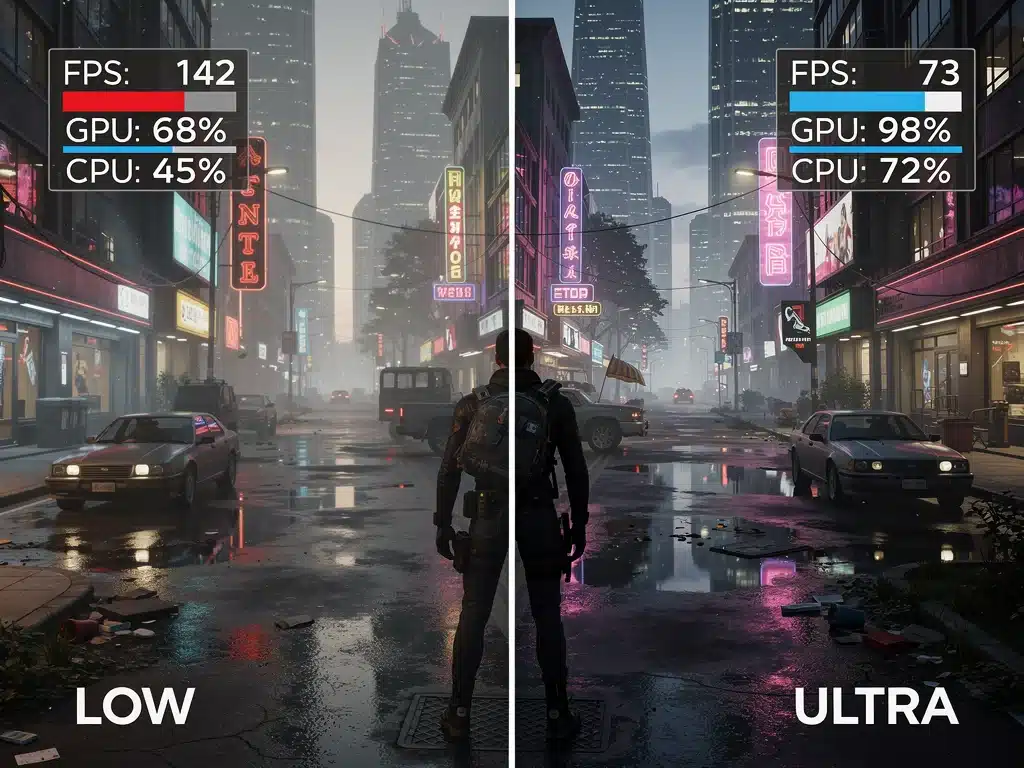
A meaningful game performance evaluation requires consistent hardware, graphics settings, resolution, drivers and gameplay sequences so comparisons are not distorted by unrelated variables.
Average FPS is useful, but frame-time behavior and low-percentile performance can reveal stutter or uneven delivery that an average alone can hide.
Testing should also identify whether a title is primarily limited by GPU rendering, CPU processing, memory capacity, storage behavior or a combination of several components.
Average FPS Does Not Tell the Entire Story
A game performance averaging 70 FPS can still feel inconsistent if frame times repeatedly spike during traversal, shader compilation, asset streaming or crowded scenes.
Measurements such as 1% lows provide additional context by showing how performance behaves during slower moments rather than representing only the overall average.
Frame-time graphs are especially useful when investigating short stutters because they reveal individual delays that may disappear inside a broad FPS average.
Use Identical Test Conditions When Comparing Hardware
Comparing two GPUs is meaningful only when CPU, memory, game performance version, drivers, resolution and graphics settings remain sufficiently consistent between test runs.
Background applications and operating-system activity can also influence results, particularly when evaluating CPU-limited scenarios or systems with relatively little available memory.
Repeated benchmark runs can help determine whether a result is consistent or whether one unusually fast or slow run distorted the conclusion.
Code Vein II Sets the Highest Hardware Bar of the Three
Code Vein II is the most demanding of the three January releases examined here according to the publisher’s official PC specifications.
Bandai Namco lists Windows 11, 16 GB of RAM and a GTX 1660 Super, Radeon RX 5700 or Intel Arc B570 among the minimum graphics requirements.
The published minimum target is Full HD at Low settings with a stated performance goal of stable performance above 30 FPS.
Recommended Hardware Targets 1080p Above 60 FPS
Bandai Namco recommends an Intel Core i7-12700KF or AMD Ryzen 7 7800X3D alongside an RTX 3080 or Radeon RX 6800 for Code Vein II.
The official target associated with that configuration is Full HD resolution, High settings and performance described as stable above 60 FPS.
That is an unusually substantial CPU recommendation for a 1080p target and indicates that players should not judge the game’s requirements from GPU model alone.
Sixteen Gigabytes of RAM Is the Official Requirement
Both the minimum and recommended configurations list 16 GB of system memory, so the official specifications do not establish 32 GB as necessary for this game.
More memory can still help a PC running browsers, streaming software or other applications simultaneously, but that is different from proving the game performance itself requires 32 GB.
Players should therefore avoid upgrading memory based solely on a generic claim that every new 2026 title needs 32 GB.
Cairn Has Much More Accessible PC Requirements
Cairn, released on January 29, provides a useful contrast because its official requirements are substantially lighter than those of Code Vein II.
The minimum specification lists an Intel Core i7-6700 or Ryzen 5 1500X and a GeForce GTX 1050 Ti or Radeon RX 570.
The developer also lists only 8 GB of RAM at both minimum and recommended levels, demonstrating how dramatically memory requirements can differ between modern games.
Recommended GPUs Remain Older Mainstream Models
The recommended graphics cards for Cairn are a GeForce RTX 2060 Super or Radeon RX 5700, paired with an i7-10700 or Ryzen 7 3700X.
Those components are considerably less demanding than the official recommended hardware for Code Vein II, particularly on the GPU side.
This difference illustrates why broad statements about “2026 gaming requirements” are misleading when games use different engines, graphical techniques and design priorities.
Cairn Explicitly Requires an SSD
The official Steam requirements for Cairn specifically state that an SSD is required at both the minimum and recommended hardware levels.
The game itself occupies only around 10 GB according to the published specifications, so capacity requirements are modest even though solid-state storage is expected.
When a developer explicitly lists an SSD requirement, that provides much stronger justification for recommending one than a generic assumption that every PC game must use the fastest available drive.
Pathologic 3 Occupies a Moderate Hardware Tier
Pathologic 3 launched on January 9, 2026 and sits between the other examples in several aspects of its documented PC hardware requirements.
The minimum configuration lists 8 GB of RAM, an unspecified i3 or Ryzen 5 processor and a GeForce GTX 960-class GPU.
The recommended configuration increases memory to 16 GB and calls for an i7 or Ryzen 7 processor together with an NVIDIA GeForce RTX 2070-class graphics card.
Storage Recommendations Matter More Than Raw Capacity
The game requires approximately 25 GB of available storage according to its Steam listing, which is modest compared with many large modern releases.
Unlike Cairn, the published information does not label an SSD as an absolute minimum requirement, but it states that the game plays best when loaded from one.
This distinction matters because “required” and “recommended” storage hardware communicate different expectations to players evaluating an upgrade.
Sixteen Gigabytes Is the Official Recommended Memory Target
The developer recommends 16 GB of RAM rather than 32 GB, so claims that 32 GB is required for smooth Pathologic 3 gameplay would need independent evidence.
Memory usage can vary according to operating-system activity and other programs running alongside the game, which can make additional capacity useful in some PCs.
That does not transform extra system memory into a universal requirement, and technical recommendations should preserve that distinction.
Comparing the Three January 2026 Games
The three games demonstrate that modern release dates alone tell players very little about the hardware necessary to achieve an acceptable experience.
Code Vein II has the highest official recommended GPU and CPU targets, while Cairn can operate on considerably older graphics hardware.
Pathologic 3 occupies a middle position and illustrates why CPU, RAM and storage recommendations should be analyzed alongside GPU requirements.
Do Not Invent FPS Results From Hardware Lists
A recommended RTX 2060 Super does not prove a game will maintain a specific frame rate at 1440p unless the developer or a controlled benchmark actually demonstrates that result.
The same limitation applies when extrapolating 4K performance from a publisher’s 1080p specification or estimating ray-tracing results without measured evidence.
A technically accurate game performance evaluation clearly labels measured benchmarks, official targets and informed expectations as different types of information.
Resolution Changes GPU Pressure Significantly
Increasing native resolution generally raises the amount of pixel-processing work required from the graphics card, making GPU performance increasingly important at 1440p and 4K.
CPU workloads do not scale in exactly the same way, which is why a system can become GPU-limited at higher resolutions while remaining CPU-limited in other scenarios.
Understanding that relationship is more useful than assuming one hardware component always determines performance in every game and configuration.
CPU Bottlenecks Need Scenario-Specific Testing
CPU limitations often become visible in games with complex simulations, large numbers of characters, substantial physics workloads or very high target frame rates.
A powerful GPU cannot completely compensate when the CPU is unable to prepare frames or process game logic quickly enough for the desired performance.
Testing CPU performance therefore requires selecting scenes that create meaningful processor workloads rather than drawing conclusions from one quiet indoor benchmark.
Low Resolution Can Expose CPU Limits More Clearly
Reducing resolution or graphical load can allow a GPU to render frames faster, increasing the likelihood that the processor becomes the limiting component.
Hardware reviewers often use this approach when comparing CPUs because it reduces GPU constraints that could otherwise hide differences between processors.
For an ordinary player, however, the most useful test remains the resolution and visual settings they actually intend to use.
GPU Utilization Can Provide Diagnostic Context
A graphics card consistently operating near full utilization while frame rate changes with resolution often indicates a predominantly GPU-limited workload.
Lower GPU utilization does not automatically prove a CPU bottleneck because frame caps, engine behavior, loading, memory or other factors can also reduce utilization.
Monitoring multiple metrics together produces a more reliable diagnosis than interpreting a single utilization percentage in isolation.
Frame Pacing Matters as Much as High Average FPS
Consistent presentation of frames often has a major effect on perceived smoothness, particularly when two systems produce similar average FPS figures.
A sequence of evenly delivered frames generally feels smoother than one alternating rapidly between short and long frame times despite sharing the same average.
This is why technical reviews increasingly supplement FPS figures with percentile lows or frame-time measurements when evaluating game performance.
Shader Compilation Can Create Short Stutters
Some PC games compile shaders during gameplay or when encountering new effects, potentially causing brief frame-time spikes depending on the engine and implementation.
Other games compile substantial shader data before gameplay begins, trading additional startup time for potentially smoother runtime behavior.
The existence and severity of shader-related stutter must be measured for each title rather than assumed solely from the graphics API or game performance engine.
Asset Streaming Can Also Affect Smoothness
Open environments frequently load textures, geometry and other assets while the player moves through the world instead of loading everything at startup.
Storage speed, memory capacity, engine design and asset-management systems can all influence how smoothly this streaming process occurs.
Visible texture pop-in or traversal stutter can therefore involve several subsystems and should not automatically be attributed to one slow component.
Graphics Drivers Can Improve Compatibility but Are Not Magic Fixes
NVIDIA, AMD and Intel regularly release graphics drivers containing game-specific profiles, fixes and optimizations for newly released titles.
Installing a current stable driver is a sensible troubleshooting step when a new game performance experiences documented compatibility or performance problems with an older version.
However, drivers cannot guarantee large performance improvements or repair fundamental engine-level optimization problems in every game.
Latest Does Not Always Mean Faster in Every game performance
A new driver can improve one title while producing little measurable difference in another, depending on what changes the vendor actually implemented.
Occasional regressions can also occur, which is why benchmark comparisons should record the exact driver version used during testing.
Players experiencing no problems do not necessarily need to perform clean driver installations repeatedly simply because another update becomes available.
Game Patches Can Matter as Much as Driver Updates
Developers can improve CPU scheduling, asset streaming, shader behavior and graphics settings through game updates independently of GPU-driver changes.
A January 2026 performance patch for Monster Hunter Wilds, for example, produced measurable improvements in independent testing while still leaving demanding scenes below a locked 60 FPS.
This illustrates why current game performance version should always be recorded alongside hardware and driver information in any reproducible performance comparison.
Upscaling and Frame Generation Change Modern Performance Testing
Technologies such as DLSS, FSR and XeSS allow games to render internally at a lower resolution and reconstruct an image closer to the target output resolution.
These techniques can significantly improve GPU-limited performance, although image quality varies with rendering resolution, implementation and selected quality mode.
Benchmark results should always state whether upscaling was enabled because native rendering and reconstructed rendering are not directly equivalent workloads.
Frame Generation Should Be Reported Separately
Frame-generation technologies can insert generated frames between traditionally rendered frames, increasing the frame rate displayed by an FPS counter.
Because generated frames do not reduce all components of input latency in the same way as higher native rendering performance, the distinction matters during analysis.
A benchmark should identify base rendering performance and frame-generated output rather than presenting the larger generated number without explanation.
Ray Tracing Performance Is Game-Specific
Ray tracing can increase GPU workload substantially, but the performance cost depends on which effects are enabled and how heavily the game uses them.
Some titles implement limited reflections or shadows, while others use more extensive path-traced lighting that demands considerably more processing power.
Technical reviews should therefore measure the actual feature instead of assuming one universal percentage performance penalty across all games.
Dynamic Resolution Scaling Can Help Maintain a Target
Dynamic resolution scaling changes internal rendering resolution according to available performance headroom in an effort to stay closer to a selected frame-rate target.
The technique can be especially useful on fixed-performance hardware or during games whose GPU workload changes substantially between different scenes.
Its effectiveness depends on implementation, because aggressive resolution reductions can become visually noticeable even when frame-rate stability improves.
Dynamic Resolution Is Not the Same as DLSS or FSR
Dynamic resolution describes the process of changing internal resolution automatically, while modern reconstruction technologies describe methods used to create the final output image.
A game performance can combine both concepts by dynamically adjusting an internal resolution before passing the lower-resolution image through an upscaling system.
Knowing which technique is active helps players understand why visual quality or performance changes during demanding scenes.
A Stable Target Can Feel Better Than a Higher Variable Average
Some players may prefer a consistent 60 FPS presentation over performance that fluctuates continuously between much higher and lower values.
Others with variable-refresh-rate displays may tolerate broader fluctuations without experiencing the same visible tearing or pacing problems.
Performance recommendations should therefore consider display capabilities and personal preferences rather than treating one FPS number as universally ideal.
How Much RAM Do PC Games Need in 2026?
There is no universal RAM requirement for 2026 gaming because memory demand varies considerably among engines, game types and background software configurations.
The three real January examples demonstrate this directly: Cairn lists 8 GB even at recommended settings, while Code Vein II requires 16 GB.
Pathologic 3 lists 8 GB as its minimum and 16 GB as recommended, making a blanket statement that all new games require 32 GB inaccurate.
Sixteen Gigabytes Remains Viable for Many Games
Many PC releases continue officially supporting 16 GB configurations, particularly when users avoid running large numbers of memory-intensive applications simultaneously.
The suitability of that capacity depends on the specific game performance and total system workload rather than the calendar year printed on the release date.
Checking official requirements and actual memory usage is more reliable than upgrading simply because a broad hardware trend suggests more capacity.
Thirty-Two Gigabytes Can Still Be Useful
Thirty-two gigabytes can provide additional headroom for multitasking, content creation, heavily modded games and titles that demonstrate unusually high memory consumption.
Extra capacity may also reduce pressure when a user keeps browsers, voice applications, capture software and launchers active while playing.
That makes 32 GB a practical configuration for many new builds without making it a mandatory baseline for every current game performance.
SSD Recommendations Should Follow the Game’s Requirements
Solid-state storage has become increasingly important as modern games stream larger quantities of data and developers design around faster storage access.
Some games explicitly require SSD storage, while others merely recommend it for reduced loading times or smoother asset delivery.
The technical distinction matters because calling an SSD “mandatory” should be reserved for games whose developers actually establish that requirement.
Cairn Explicitly Lists an SSD as Required
The official PC requirements for Cairn include an SSD requirement under both its minimum and recommended specifications.
That provides a clear reason for players using mechanical drives to consider moving the game performance to solid-state storage before diagnosing other performance problems.
It does not mean a PCIe Gen5 NVMe drive is necessary, because the official specification simply states SSD rather than requiring the fastest available interface.
Pathologic 3 Recommends Rather Than Requires an SSD
Pathologic 3 lists 25 GB of storage and states that the game performance plays best when loaded from an SSD.
This language indicates a recommendation rather than the strict storage requirement shown for Cairn, and the distinction should remain clear in technical guidance.
Players should also avoid assuming that moving from one already-fast NVMe SSD to a faster generation will automatically produce higher gameplay frame rates.
Future Trends in Game Performance Evaluation
PC benchmarking is becoming more complex as reconstruction, frame generation, ray tracing and increasingly scalable graphics systems change what a single FPS number represents.
CPU performance also remains important as games increase simulation complexity and high-refresh-rate monitors encourage players to target substantially more than 60 FPS.
Future game performance evaluation will increasingly need to explain image-generation techniques and latency alongside traditional rendering metrics.
Native Rendering Will Remain an Important Baseline
Testing without upscaling can reveal the underlying GPU workload and provide a common baseline before reconstruction or frame-generation technologies are activated.
That does not mean native rendering is always the best configuration for actual gameplay, especially when quality upscaling produces a strong image with substantially higher performance.
Reporting both approaches gives players enough information to choose the trade-off that best matches their hardware and display.
Performance Presets Need Better Documentation
Terms such as Low, Medium, High and Ultra do not have standardized meanings across different games and can represent dramatically different visual and computational workloads.
Publisher-provided performance targets like those published for Code Vein II are particularly useful because they connect hardware, resolution, settings and frame-rate expectations.
More detailed official targets would make it easier for players to understand requirements before purchase and for reviewers to compare real-world behavior against developer expectations.
Cloud Gaming Adds Network Performance to the Equation
Cloud gaming shifts much of the graphics rendering workload from the local PC to remote server hardware.
This can allow comparatively modest devices to display demanding games, but network latency, bandwidth stability, compression and server availability become major parts of the experience.
Cloud performance therefore requires a different evaluation methodology from locally rendered PC gaming, even when the underlying game performance is identical.
Latency Matters More Than Raw Download Speed Alone
A fast internet connection can still deliver an unsatisfactory cloud-gaming experience when latency or packet instability between the user and server is high.
Competitive or timing-sensitive games can make these delays more noticeable than slower experiences where rapid input response is less critical.
Cloud-game reviews should therefore examine network conditions rather than claiming that one broadband speed guarantees the same experience for every player.
Cloud Gaming Is Complementary Rather Than a Universal Replacement
Local installation still provides advantages including offline access, direct hardware control, mod support in many games and independence from streaming-service availability.
Cloud services can provide convenience across devices, especially for users who do not own sufficiently powerful gaming hardware.
The two approaches can coexist, making claims that cloud gaming will automatically replace local downloads inappropriate without much stronger market evidence.
Practical Hardware Recommendations for 2026 Players
The most useful hardware recommendation begins with the specific games, resolution and target frame rate a player actually intends to use.
A PC designed for Cairn at modest settings does not require the same graphics hardware as a system targeting the official High preset in Code Vein II.
Buying components according to real requirements usually produces better value than applying one expensive “2026 gaming PC” specification to every player.
Prioritize the Component That Limits Your Actual Games
A player whose GPU remains fully loaded at the desired settings may gain more from a graphics upgrade than from replacing an already-capable processor.
Someone targeting very high frame rates in CPU-heavy games may instead benefit significantly from a stronger CPU while keeping the existing graphics card.
Monitoring utilization and frame-time behavior can help identify the real limitation before purchasing new hardware.
Avoid Upgrading Solely for Future-Proofing
No PC component can guarantee compatibility or maximum settings across all future games because software requirements and rendering techniques continue to evolve.
Buying some additional performance headroom can be reasonable, but spending substantially more for hypothetical future requirements may provide poor value.
A balanced system built around current needs and a realistic upgrade path is usually more defensible than promising a configuration will remain “future-proof.”
| January 2026 Game | Official PC Performance Context |
|---|---|
| Code Vein II | 16 GB RAM minimum; recommended RTX 3080/RX 6800 and i7-12700KF/Ryzen 7 7800X3D for 1080p High above 60 FPS. |
| Cairn | 8 GB RAM; recommended RTX 2060 Super/RX 5700; SSD explicitly required. |
| Pathologic 3 | 8 GB minimum and 16 GB recommended RAM; GTX 960 minimum and RTX 2070 recommended; SSD recommended. |
| General Testing | Record resolution, preset, driver, game version, upscaling, frame generation, average FPS, lows and frame-time behavior. |
Frequently Asked Questions About Game Performance Evaluation
There is no single perfect metric. Average FPS, 1% lows, frame-time consistency, input responsiveness and visible stutter together provide a more complete picture of performance.
No. Requirements vary substantially. Cairn lists 8 GB at both minimum and recommended levels, while Code Vein II requires 16 GB. Thirty-two gigabytes can provide useful multitasking headroom but is not a universal game performance requirement.
No. Driver updates can add game-specific optimizations, compatibility fixes and stability improvements, but performance gains vary by title and some updates may produce little measurable FPS difference.
It depends on the game performance. Cairn explicitly requires an SSD, while Pathologic 3 recommends one. Players should check each game’s official requirements rather than assuming the same storage rule applies universally.
Dynamic resolution scaling changes the internal rendering resolution according to performance conditions in an effort to remain closer to a selected frame-rate target.
Not without explanation. Frame generation adds generated frames between traditionally rendered frames, so benchmark reports should distinguish base rendering performance from the final generated frame-rate output.
Use an in-game benchmark or a monitoring tool to record FPS, frame times, CPU and GPU utilization. Keep resolution and graphics settings consistent when comparing changes and repeat tests when possible.
Looking Ahead: PC Game Performance in 2026
The January 2026 releases demonstrate that game performance cannot be summarized through one universal hardware recommendation because modern titles continue to target very different PCs.
Technologies such as reconstruction, frame generation and dynamic resolution also make performance analysis more nuanced, requiring reviewers to explain how each measured FPS figure was produced.
For players, the most reliable strategy remains checking official requirements, consulting reproducible benchmarks and adjusting settings according to actual hardware instead of relying on unsupported performance claims.