Best Co-op Games to Play with Friends: An In-Depth Analysis

Advertisements
The 6 best co-op games to play with friends in 2026 span dedicated two-player adventures, three-player action survival, four-player hunting, squad shooters, expansive RPGs and cooperative deckbuilding. This guide focuses on real games available in 2026 and the specific cooperative mechanics that make each one worth considering.
Finding the best co-op games 2026 has to offer is less about choosing the newest release and more about matching a game to your group. Some experiences demand constant two-player coordination, while others support larger squads and more flexible sessions.
The strongest options available in 2026 also represent very different genres. Friends can explore elaborate fantasy worlds, hunt enormous monsters, survive punishing expeditions, fight galactic wars or build decks together without relying on the same style of cooperative design.
This analysis focuses on six verified games that can actually be played in 2026: Split Fiction, Elden Ring Nightreign, Monster Hunter Wilds, Helldivers 2, Baldur’s Gate 3 and Slay the Spire 2.
Advertisements
The Strength of co-op game in 2026
Co-op games will remain one of the most varied parts of the gaming landscape in 2026. Players can choose between tightly scripted adventures designed exclusively for two people and open-ended multiplayer games that support longer-term progression with larger groups.
Recent releases have also demonstrated that cooperation can be a core design principle rather than an optional multiplayer mode. Split Fiction, for example, is built specifically around two players, while Elden Ring Nightreign restructures FromSoftware’s familiar combat around expedition-based cooperative survival.
At the same time, established games such as Helldivers 2 and Baldur’s Gate 3 remain strong choices in 2026 because their multiplayer systems continue to create unpredictable situations when friends coordinate, improvise or occasionally interfere with one another.
Criteria for Identifying Top Co-op Titles
Selecting six standout games requires looking beyond review scores or release dates. A strong Co-op games should give players meaningful reasons to work together rather than simply allowing several people to occupy the same world simultaneously.
Group size also matters. A game designed around exactly two players serves a different audience from one supporting three or four friends, so this list considers how clearly each title communicates its intended cooperative structure.
Replayability, accessibility, communication demands and mechanical variety were also considered. The result is not an objective universal ranking, but a selection representing some of the strongest and most distinctive cooperative experiences available to friends in 2026.
Innovative Mechanics and Gameplay Design
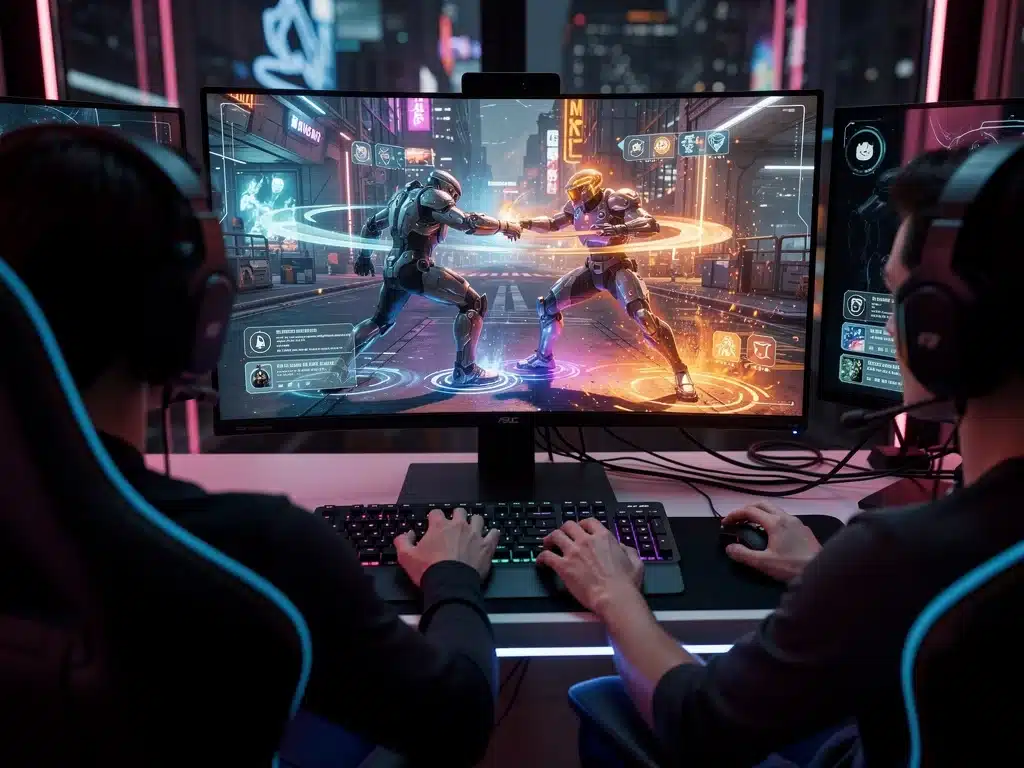
The best cooperative mechanics give one player’s actions consequences for everyone else. That can mean simultaneously solving a puzzle, building complementary character roles or coordinating positioning during a difficult combat encounter.
Split Fiction constantly changes the abilities available to its two protagonists, while Slay the Spire 2 introduces multiplayer-specific cards and team synergies. These systems make cooperation part of the underlying design rather than an additional feature.
Other games encourage collaboration through systemic freedom. Baldur’s Gate 3 allows party members to separate, pursue different objectives and combine environmental effects in combat, which can produce solutions the developers do not explicitly prescribe.
Social Integration and Communication
Communication requirements vary significantly between these games. Elden Ring Nightreign rewards rapid decisions during compressed expeditions, while Monster Hunter Wilds asks hunters to understand monster behavior and coordinate around different weapons and opportunities.
Not every game requires constant voice chat. Turn-based titles such as Baldur’s Gate 3 and Slay the Spire 2 give groups more time to discuss decisions, making them useful alternatives for players who prefer strategic conversation over reflex-driven coordination.
Cross-platform support can also make organizing a group easier, although availability differs by game. Split Fiction is particularly flexible because its Friend’s Pass supports cross-platform online play while requiring only one member of the pair to own the full game.
- Meaningful mechanics that reward cooperation rather than simple proximity.
- Group sizes ranging from dedicated two-player experiences to four-player teams.
- Different communication demands for action, strategy and role-playing groups.
- Replayability through changing encounters, builds, decisions or mission structures.
Game 1: Split Fiction
Split Fiction remains one of the clearest recommendations for two friends in 2026 because Hazelight designed the entire adventure around cooperation. Players control Mio and Zoe, two writers trapped inside simulations based on their science-fiction and fantasy stories.
Every chapter introduces different mechanics rather than relying on one permanent combat system. Players encounter platforming, puzzles, action sequences, stealth elements and unusual transformations that repeatedly require the pair to coordinate timing and abilities.
The Friend’s Pass makes the game especially convenient for a duo. One person can own the complete game and invite another player to join the entire online adventure without requiring that second person to purchase another full copy.
Two-Player Mechanics and Friend’s Pass
Split Fiction is specifically designed for two players rather than scaling a single-player adventure into multiplayer. Both characters frequently receive different abilities, meaning neither participant can independently complete the challenges intended for the pair.
The game supports local split-screen as well as online multiplayer. Its Friend’s Pass also supports cross-platform play across supported systems, helping friends play together even when they do not own identical gaming hardware.
Its constant mechanical variety makes Split Fiction particularly suitable for players who become bored with repetitive co-op loops. The trade-off is equally clear: it is a two-player experience, so groups of three or four need another option.
Game 2: Elden Ring Nightreign
Elden Ring Nightreign transforms elements of FromSoftware’s action-RPG formula into a session-based cooperative survival experience. Players enter Limveld as Nightfarers and rapidly gather levels, equipment and resources before confronting increasingly dangerous nighttime bosses.
The standard multiplayer structure is built around three-player teams, although the game also supports solo play. Each Nightfarer has distinctive skills and an ultimate ability, making character composition and coordination important during difficult encounters.
Rather than offering the slower open-world exploration of Elden Ring, Nightreign compresses progression into individual expeditions. That makes it one of the more demanding choices among the best co-op games 2026 players can choose.
Expeditions, Nightfarers and Team Synergy
Each expedition places pressure on the group to become stronger quickly. Players need to choose where to explore, which enemies to confront and which equipment is worth pursuing before the map becomes increasingly constrained by the approaching Night.
Different Nightfarers support different approaches to combat. A team can combine ranged pressure, melee resilience, magic or support-oriented abilities, and effective coordination becomes increasingly important against the more punishing Nightlords.
The game’s difficulty also makes it less universally accessible than some entries on this list. Groups familiar with action RPGs may appreciate the challenge, while friends primarily seeking a relaxed social experience may find another title more suitable.
- Group size: Designed around three-player online cooperative expeditions.
- Structure: Session-based runs through the changing region of Limveld.
- Team design: Distinct Nightfarers provide complementary abilities and play styles.
- Best for: Groups seeking demanding action and repeated boss encounters.
Game 3: Monster Hunter Wilds
Monster Hunter Wilds is one of the strongest choices for a group that enjoys progression built around increasingly difficult battles. Its online cooperative mode supports teams of up to four hunters pursuing large monsters across dynamic environments.
The core loop revolves around studying monsters, completing hunts and using acquired materials to craft stronger weapons and armor. Different weapon types behave dramatically differently, allowing friends to develop specialized roles without forcing them into rigid traditional RPG classes.
Because progression is tied to hunting and equipment, Monster Hunter Wilds works particularly well for groups that want a game they can return to over many sessions instead of finishing during a single narrative campaign.
Four-Player Hunts and Weapon Variety
A four-player hunt can combine weapons with very different ranges, speeds and defensive capabilities. One hunter may remain close to a monster’s head while another attacks from range or concentrates on different vulnerable areas.
Cooperation is useful even though each hunter retains substantial individual freedom. Groups can assist one another during dangerous encounters, exploit openings created by teammates and coordinate equipment according to the target being hunted.
The game’s systems require some learning, particularly for newcomers unfamiliar with Monster Hunter. That investment can become part of its appeal, however, because understanding a weapon or monster gradually produces a strong sense of collective progression.
Game 4: Helldivers 2
Helldivers 2 remains an excellent option in 2026 for groups seeking short, chaotic cooperative missions rather than a traditional campaign. Up to four players deploy together to complete objectives while fighting overwhelming enemy forces.
The central mechanic is cooperation under pressure. Players call in weapons, ammunition, airstrikes and other Stratagems using command inputs, but those powerful tools can also injure teammates if used carelessly because friendly fire is part of the experience.
That combination of tactical coordination and accidental disaster gives the game much of its identity. A perfectly planned mission can rapidly become chaotic when an orbital strike lands in the wrong place or a retreat separates the squad.
Game 5: Baldur’s Gate 3
Baldur’s Gate 3 remains a compelling cooperative RPG in 2026 despite originally releasing earlier. Larian’s campaign supports online multiplayer for up to four players, allowing friends to share a long narrative while making decisions that can dramatically change the story.
The game’s turn-based combat gives groups time to discuss tactics, examine the environment and combine spells or abilities. Outside combat, party members can split up, explore different locations and occasionally trigger consequences without the rest of the group being present.
That freedom makes multiplayer unpredictable in a way that differs from tightly scripted Co-op games. One friend can pursue a diplomatic conversation while another steals an object nearby, potentially transforming what seemed like a peaceful encounter into a completely different situation.
Shared Choices and Tactical Freedom
Up to four players can create characters or use available Origin characters and travel through the campaign together. Because conversations and decisions can affect quests and relationships, cooperation extends beyond simply winning battles.
Combat follows a turn-based system inspired by Dungeons & Dragons, giving players opportunities to combine positioning, environmental effects, spells and class abilities. Different party compositions can therefore approach the same encounter in very different ways.
The greatest strength is also a potential complication: a full campaign represents a substantial time commitment. Groups that struggle to maintain a regular schedule may find shorter session-based games easier to organize than a lengthy shared RPG.
- Online group size: Up to four players.
- Co-op focus: Shared exploration, choices, dialogue and turn-based combat.
- Replayability: Different classes, decisions and quest outcomes can change subsequent playthroughs.
- Best for: Groups wanting a long-form narrative RPG rather than short missions.
Game 6: Slay the Spire 2
Slay the Spire 2 provides the most clearly 2026-specific entry on this list. Mega Crit released the sequel into Steam Early Access on March 5, 2026, expanding the deckbuilding roguelike formula with an entirely new cooperative mode.
Up to four players can now climb the Spire together. Instead of merely placing several independent card-game sessions side by side, the multiplayer design includes cards and synergies created specifically around Co-op games play.
The Early Access status is important when evaluating it among the best co-op games 2026. The game is playable now, but Mega Crit has explicitly stated that additional cards, events, environments, enemies and balancing changes will continue arriving during development.
Cooperative Deckbuilding and Team Synergies
Each participant builds a deck around a chosen character while considering how individual cards interact with the wider group. That gives players opportunities to create combinations that would not exist during a solo climb.
Because combat is turn-based, the game emphasizes discussion and planning rather than fast reactions. Friends can analyze threats, coordinate resources and decide which player is best positioned to solve a particular problem during an encounter.
Procedural runs provide substantial replayability, while the Early Access format means the game will continue changing. Players who enjoy participating during active development may see that as a benefit, while those wanting a finished release may prefer to wait.
| Key Feature | Description |
|---|---|
| Dedicated Co-op Design | Split Fiction and Nightreign build major parts of their core gameplay around collaboration rather than adding co-op as an afterthought. |
| Different Group Sizes | Options range from Split Fiction’s dedicated two-player structure to several games supporting groups of up to four. |
| High Replayability | Randomized expeditions, hunts, branching RPG decisions and roguelike deckbuilding provide different reasons to return. |
| Genre Variety | The selection covers action adventure, survival, hunting, shooting, role-playing and strategic deckbuilding. |
Frequently Asked Questions About Co-op Games in 2026
Looking Ahead: The Future of Cooperative Play
The strongest Co-op games available in 2026 demonstrate that there is no single formula for successful shared play. A tightly controlled two-player adventure can coexist with large RPG campaigns, repeatable action expeditions and strategic card-based runs.
The most important factor is how directly a game makes friends depend on or meaningfully interact with one another. Split Fiction, Nightreign and Slay the Spire 2 make that relationship explicit, while the other selections create cooperation through flexible multiplayer systems.
For groups choosing among the best co-op games 2026, the practical question is therefore not which title is universally superior, but which structure fits the group. Two players may prefer Split Fiction, tactical trios can tackle Nightreign, while groups of up to four have several excellent alternatives.